Marne Aval Supervision
Designing a real-time industrial dashboard to help wastewater plant operators move from alarm overload to predictive availability indicators.
Project Overview
The Marne Aval (MAV) plant processes 75,000 m³ of wastewater daily for 16 communes. SIAAP (Service public de l'assainissement francilien) commissioned a digital dashboard to visualize the real-time availability of equipment across the plant. The project brought together the design agency Attoma, engineering firm ERAS, and software specialist UReason.
Challenge & Context
The plant's operators faced severe information saturation. The system generated approximately 1,600 alarms per day, with 350 to 400 active permanently. This volume desensitized operators — they filtered out Level 2 alarms and risked missing critical issues. The challenge: move from a reactive model based on a raw fault list to a proactive model based on functional availability indicators.
Project Goals
- Reduce alarm saturation. Implement filtering and prioritization rules to present only actionable information, reducing cognitive load on operators.
- Decision support. Create specific indicators per trade (maintenance, process) to improve anticipation of equipment failure and facilitate shift handovers.
- Harmonization. Define a standard for alarm management and visual interfaces deployable across multiple sites.
User Research & Discovery
To understand the industrial context, we used an immersive methodology.
We conducted observations on the "File Eau" (Water line) and "File Boue" (Sludge line) to map usage journeys and identify pain points in the existing multi-channel environment (screens, tablets, wall charts).
Three key personas emerged: the Shift Team Leader (monitoring and piloting), the Maintenance Service team, and the "Cellule BPE" (Process Study Unit).
The critical insight: operators needed to know the availability of a function — "Is the Dehydration zone operational?" — not the technical status of a single sensor. The raw alarm list obscured the actual health of the plant.
Design Process & Approach
The project ran as a rigorous co-conception process over 10 months.
Discovery & rules (offline). We worked with the ERAS engineering team to define functional calculation rules. For example: a "Pre-treatment" zone is "Available" even if 1 out of 4 pumps is down, provided the flow rate is met.
Co-conception workshops. We facilitated 5 major workshops with SIAAP operators and stakeholders to validate the information hierarchy, define navigation paths, and test clickable prototypes.
Iterative prototyping. We used InVision to create dynamic prototypes, letting operators test scenarios like "Threshold Crossing Alerts" or "Bypass Alerts" before development.
Solution & Key Features
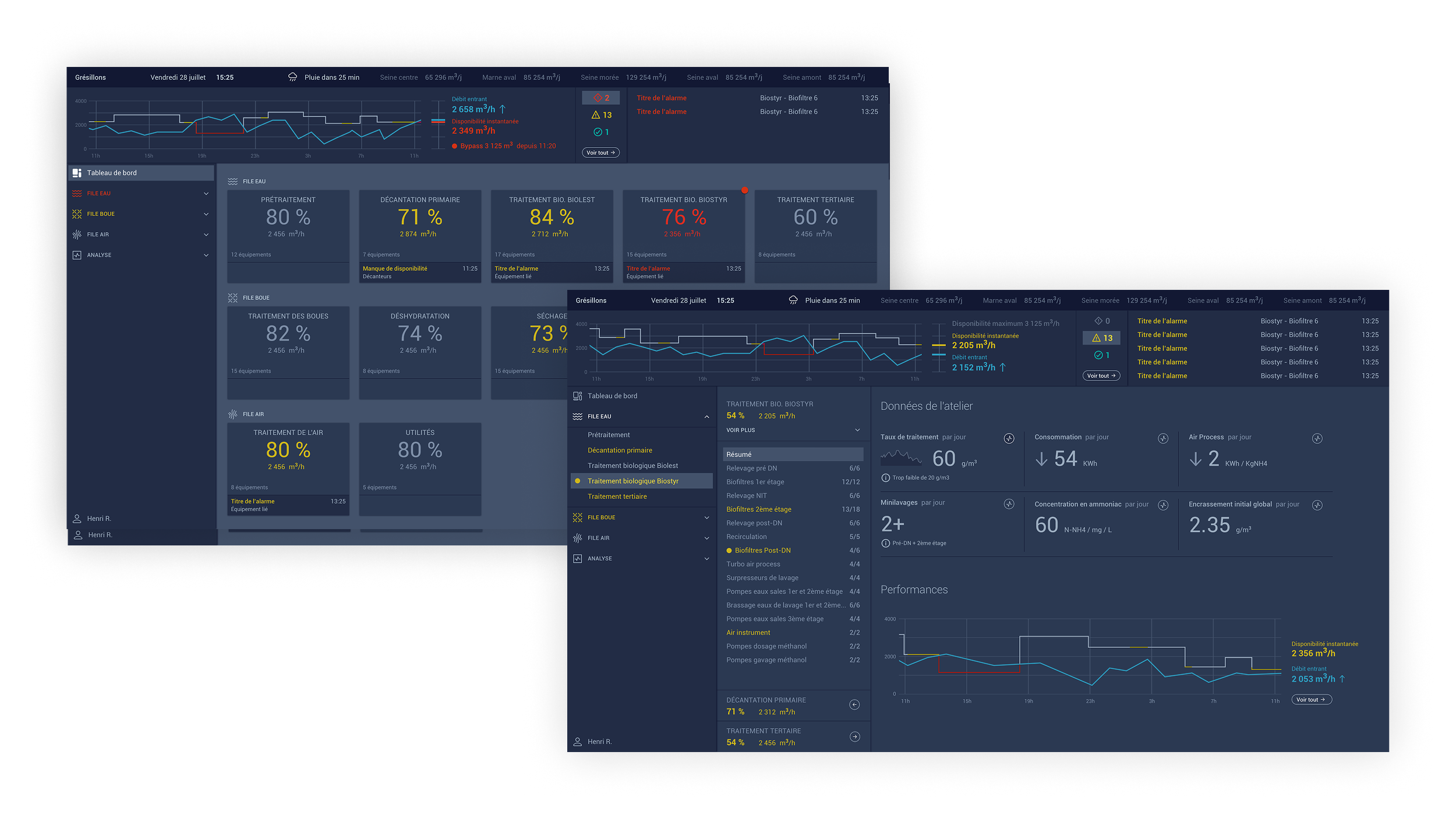
The final solution was a touch-optimized "Tableau de Bord" integrated with Wonderware InTouch and OASYS-AM systems.
Availability indicators. Instead of listing faults, we designed a visual system: Green (RAS/Level 0), Orange (Alert/Level 2), Red (Critical/Level 3) to indicate the computed availability of each equipment group.
Plant navigation. Horizontal tabs give operators instant access to specific plant sections (Pre-treatment, Biological Treatment, Incineration) and their availability rates.
Common Trade Screen. A shared screen readable from 3 meters away aggregates real-time data from different trades to facilitate cross-team coordination.
Visual Design
A strict color code was applied: Grey indicated "RAS" for Ateliers, Green indicated "RAS" for specific equipment, so colored elements (Orange/Red) immediately drew attention to anomalies.
For the large Common Trade Screen, we established specifications requiring a minimum font size of 30px and sans-serif fonts (Arial/Verdana) to ensure readability from 3 meters.
My Role
As part of the Attoma design team, I modeled user journeys and analyzed the existing information architecture, participated in workshop facilitation to define functional rules and interface needs, designed the interface screens and visual language (icons, typography, contrasts), and created the InVision prototypes for validation.